Start with what you already teach.
Bring lesson notes, slides and readings. These materials will give the lesson its content and keep the output tied to your sources.
We are developing a lesson design platform that starts with the educator. Share your materials and teaching goals, then shape interactive lessons, classroom games and simulations through a guided conversation.
The first prototype was built for a welfare economics course.
What should your students understand by the end of this lesson?
Why two people can both benefit from a trade. I want them to try it before I introduce the theory.
Will students negotiate in pairs, or will you guide the activity on a classroom screen?
Illustrative conversation. The general authoring workflow is in development.
The planned Claude API workflow will use the educator’s own materials and answers to shape a lesson around their learning goals, students and classroom. Educators will review and edit the result before teaching.
Bring lesson notes, slides and readings. These materials will give the lesson its content and keep the output tied to your sources.
A focused conversation will clarify the lesson goal, student level, available time and preferred approach, including where students tend to struggle.
Review a proposed lesson flow with interactive explanations, games or simulations. Adjust the sequence and detail to suit your classroom.
Explore an example teaching brief
Illustrative preview · Welfare economics
For this example, the goal is to explain how voluntary trade can improve both participants’ outcomes, using a concrete exchange before naming the theory.
“Which misconception do you want this activity to address?”
This example uses a teacher-led classroom screen. Students propose exchanges, predict the outcome and decide whether both participants should accept.
“How much time can students spend negotiating before the explanation?”
The existing prototype lets students propose a fish-for-bananas trade, inspect both scores and accept or reject it. Accepted trades appear in an Edgeworth diagram.
Propose → compare → agree → inspect the result.Open the interactive lessons ↗
The founder built a browser-based teaching prototype for welfare economics. Its four weekly modules include classroom voting, an ultimatum activity, negotiation and interactive economic diagrams.
The current lesson content is in Turkish. Open Lesson 4 for the trade activity and Edgeworth diagram.
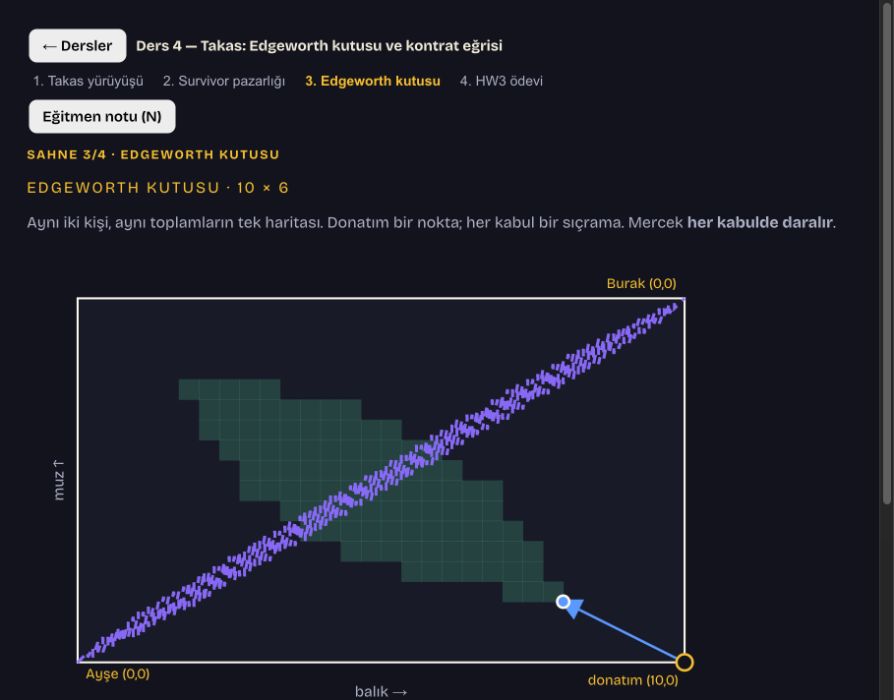
A working course prototype with four lesson modules and interactive activities. You can explore it directly in your browser.
The general material-to-lesson workflow and Claude API integration. We plan to evaluate source fidelity, learning-goal fit and educator control before an educator pilot.
AROS Lab is an independently funded project led by Erdemalp Ozden in Bayburt, Türkiye. The education product grows out of a working prototype prepared for a welfare economics course.
We plan to use the Claude API for the educator interview, understanding supplied materials and proposing editable lesson activities. The existing course prototype uses prepared content; it does not yet generate lessons through Claude.
Get in touch to discuss your teaching workflow or a future educator pilot.